Seatrade Maritime: Two dead, 15 rescued from capsized bulker off Philippines
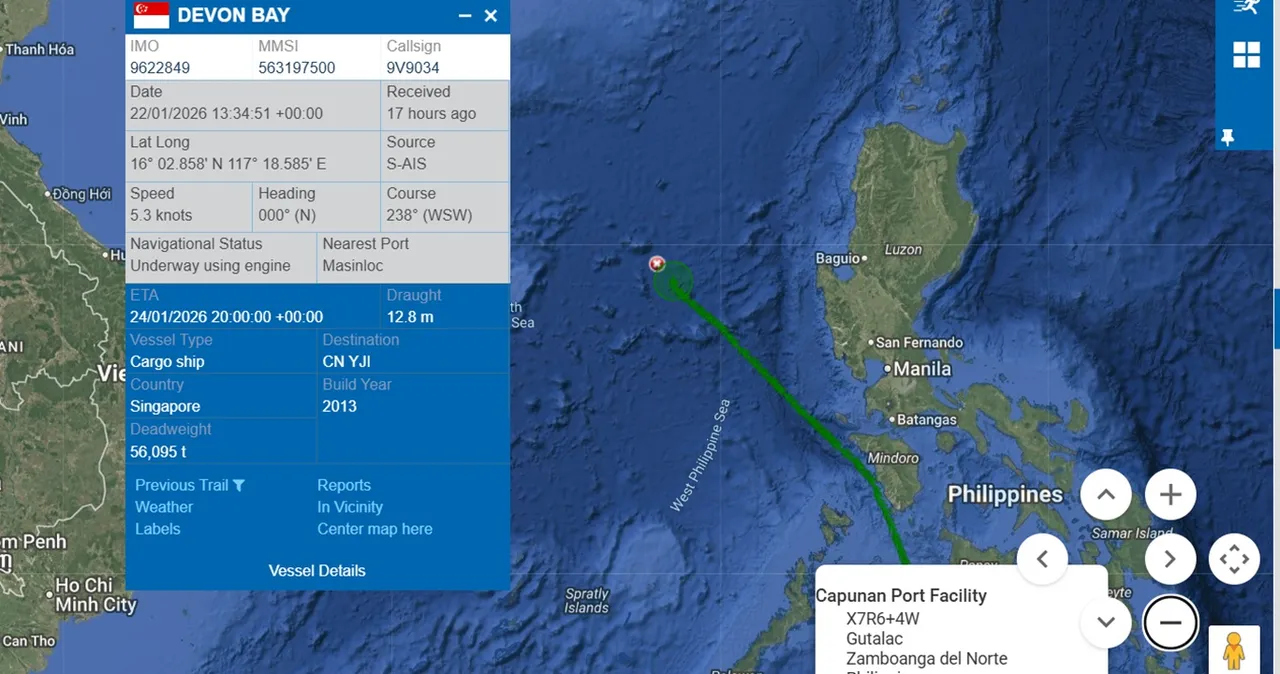
The Singapore-registered bulker Devon Bay was reported to have capsized and sank in the South China on 22 January.
The Maritime & Port Authority of Singapore, which administers the Singapore-flag, said that the crew were no longer on the vessels and that 17 out 21 crew members had reportedly been recovered, however, two had died. Search and rescue operations remained ongoing for the four missing crew members.
The Philippines Coast Guard said that the vessel’s last known position was recorded as 141 nautical miles west of Sabangan Point in the Philippines at 8:30 pm on 22 January and was reported a crew of 21 Filipinos on board.
The PCG said it received a distress report the bulker Devon Bay that the vessel was already listed at approximately 25 degrees and that on 23 January the Hong Kong Maritime Rescue Coordination Centre said 10 of the 21 crew had been rescued by a passing China Coast Guard vessel.
The Devon Bay is owned by Japanese shipowner K-Line through its Singapore-based shipowning company K Line Pte Ltd.
The 56,095, 2013-built bulker was reported to be sailing from Gutalac, Zamboanga del Sur in the Philippines to Yangjiang, China.
The Philippines Coast Guard said the vessel was loaded with a cargo of iron ore, however, its last port of call was related to a nickel ore mining facility in Southern Philippines.
Tracking data from Pole Star Global’s PurpleTrac shows that the Devon Bay’s last port of call was the Capunan Port Facility, Gutalac, Zamboanga del Norte. Capunan Port Facility is associated with a nickel ore project, making it likely that the vessel was loaded with nickel ore rather than iron ore as reported.
Nickel ore, if improperly stored on land, is prone to liquefaction which can lead to the sudden capsizing of vessel often with the loss of some or all of the crew of the vessel.
The Devon Bay was shown on 19 January as anchored at offshore position consistent with loading at nickel ore ports in southern Philippines with limited infrastructure.
Related Posts