Freightwaves: Ocean rates: New Year promises a good ‘blanking’ for US East Coast
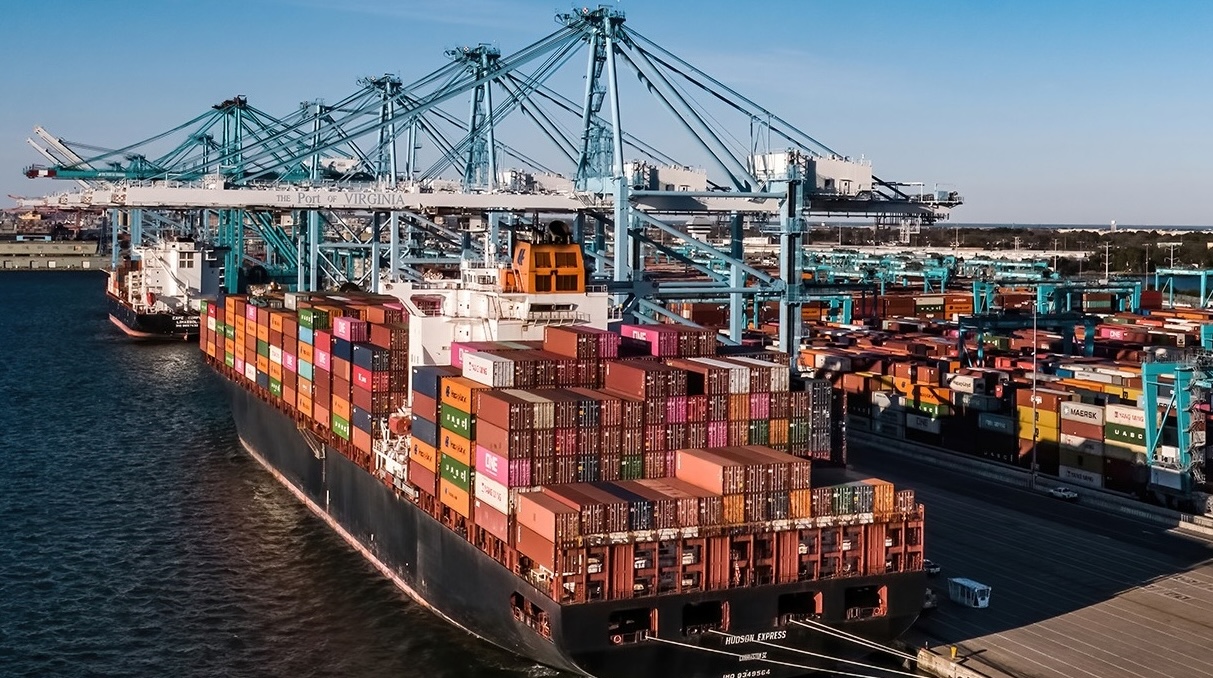
Ocean container rates got a pre-holiday bump in the latest week’s data as inbound Asia traffic continues to run stronger to the East Coast while carriers look ahead to the New Year for improvement on the West Coast.
Asia-West Coast spot rates for the week ending Dec. 14 climbed $366, or 21.3%, to $2,086 per twenty foot equivalent unit on capacity that was broadly steady, up less than 1% to 301,668 TEUs, according to analysts Xeneta and eeSea. That put rates narrowly higher from November, up $45 or 2.2% as capacity fell by 7% or 22,734 TEUs. Rates were only ahead $100, or 5%, as capacity fell by 0.4% from December 2024.
Approximately 40% of global container traffic moves under spot rates, when shippers require capacity on short notice, or when cargo is rolled, or bumped, from a previously scheduled service. In a weak market, spot pricing can offer leverage for cargo owners looking to negotiate better long-term deals with carriers.
On the East Coast, weekly spot rates gained $463, or 18.4%, to $2,982 per TEU as capacity swelled by 12,556 TEUs, or 7.2%, to 186,898 TEUs. Rates increased $236, or 8.6% month-on-month, as capacity rose by 12,913 TEUs, or 7.4%. Since Dec. 1 rates are better by $136, or 4.8% on capacity that added 15,792 TEUs, up 9.2%.
Xeneta noted many departure delays out of the East Coast, which pushed offered capacity into the next week.
“Capacity offered from Far East to U.S. West Coast is expected to increase 10.4% in January compared to December, with blanked capacity decreasing 48.5%,” said Peter Sand, chief analyst for Oslo-based Xeneta, in a research note. “It’s a different story into the U.S. East Coast with 162,219 TEUs of blanked capacity announced for the next eight weeks.
“There is a distinct difference in the services offered into U.S. East Coast and U.S. West Coast and the way carriers are managing capacity. This is motivated by underlying stronger demand into the East Coast, with the West Coast more sensitive to U.S.-China geopolitical tensions.”
Separately, the North Europe to U.S. East Coast rate for the week was unchanged at $1,566 even as capacity fell by 3,081 TEUs, or 6.2%, to 46,773 TEUs. Since November, rates were slightly lower by 1.2% despite capacity that tumbled by 21.8% or 13,047 TEUs. Rates sank by 1.1% y/y as offered capacity slipped by 6.9%.
On Asia-Mediterranean trade routes, rates climbed 18.9%, 38% and 18.4% for the week, month and year on capacity that grew 7.4%, 8.6%, and 26.1%.
Indications are that contract negotiations on Europe trades have already begun.
Average departure delays on trades from Far East to Europe reached 12.5 days for the week ending Dec.14, the second-highest level in three years, pushing many expected departures into the following week.
“These delays are not caused by carriers blanking sailings, it’s about port congestion and operational inefficiencies,” said Sand. “Shippers need to be on top of this and manage the risk of congestion and the potential for containers arriving later than expected.
“If shippers are looking to move back to just-in-time supply chains in 2026 after a just-in-case approach during the tariff chaos of 2025, they need to manage this risk and ask carriers to deliver on their promises.”
Maersk (MAERSK-B.CO) and Hapag-Lloyd (HLAG.DE), which have trumpeted the schedule reliability of their Gemini cooperation, earlier announced premium pricing for on-time delivery. Market sources indicate the Premier Alliance lines of Ocean Network Express (ONE), Hyundai Merchant Marine (HMM) and Yang Ming are also considering Gemini-like pricing.
Related Posts