Maritime Executive: China Blocks Exports to 20 Japanese Companies and Puts 20 on Concerns List
In the latest sign of rising tensions between China and Japan, China’s Ministry of Commerce announced export bans on 20 leading Japanese companies and placed an additional 20 companies on a “List of Concerns.” Japanese officials quickly responded, demanding a lifting of the restrictions, which it called “intolerable,” as it lodged a “strong protest” with Beijing.
Tensions have been rising as China continues to expand its territorial claims, with spats between the two sides over uninhabited islands used as fishing grounds. China has also objected to the reports that Japan was committed to raising military spending to two percent of gross domestic product in 2026. Many in the Japanese government have said the country must modernize its military in response to Chinese efforts. Last November, Japanese Prime Minister Sanae Takaichi also told parliament that Japan might have to respond if China attacks Taiwan.
In taking today’s steps, Chinese officials cited Japan’s efforts to enhance its military strength. The Chinese Foreign Ministry referenced “national security” and its “international obligation of non-proliferation.” The Commerce Ministry took it further by saying Japan was trying to “remilitarize” and referencing “nuclear ambitions.”
Japan has commercial nuclear power, but its post-World War II Constitution contains provisions long interpreted to block military use of nuclear weapons. It also restricts nuclear ships. Japan’s Defense Ministry, however, in 2025, made remarks about “next-generation power sources” for its submarines and other combatants.
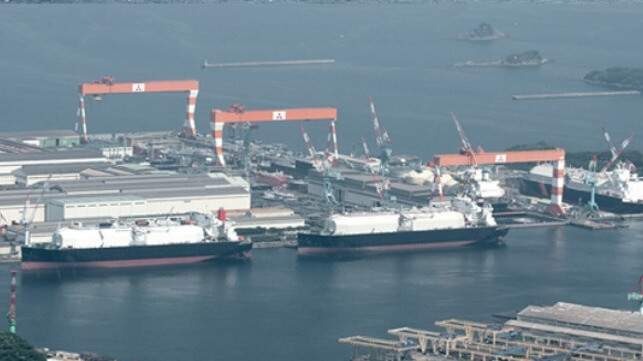
Under the restrictions launched today, Chinese companies or companies dealing with Chinese technology are immediately banned from exporting any items that can be deemed to have “dual-use,” i.e., repurposing from commercial to military purposes. The list is 20 of Japan’s leading industrial companies, including Mitsubishi Heavy Industries Shipbuilding, along with several other divisions, as well as divisions of Kawasaki and IHI involved in aerospace, Japan Marine United Corporation, and others.
The second listing is companies that China said it has concerns that they could repurpose dual-use items, and that the companies could not be verified. Exports or international companies doing business with these 20 companies now have to submit a risk assessment and provide a “written commitment that the dual-use items will not be used for any purpose that would enhance Japan’s military strength.” This includes dealings with Subaru, FUJI Aerospace Technology, ITOCHU Aviation, Sumitomo Heavy Industries, Nissin Electric, and others.
Experts highlight that China would likely include exports of rare earths and metals that could be used in electric vehicles as well as missiles. They note that China briefly restricted similar exports to Japan 16 years ago.
After filing its official protest, Japanese officials said the country would consider its “necessary responses.”
Related Posts