Maritime Executive: Op-Ed: China’s Threats Over Darwin Port Review Are Unacceptable
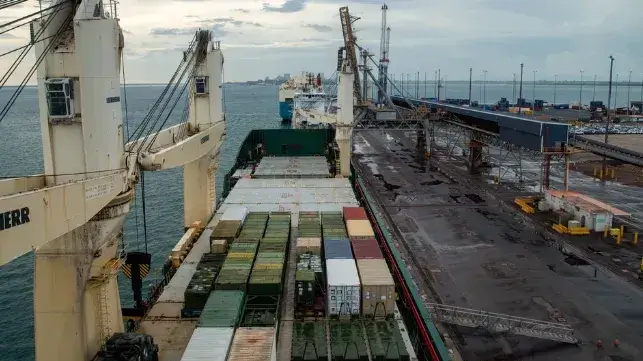
China’s ambassador has chosen a public platform to apply pressure on Australia, shape domestic debate and threaten retaliation over a sovereign national-security decision. With this, Beijing has transformed a policy review on Chinese control of Darwin Port into a test of diplomatic norms—just as it has done with Australian decisions, including 5G telecommunications and foreign interference laws.
‘If anything happens like the port will be taken back by…forceful measures, then we have an obligation to take measures to protect the Chinese company’s interests,’ the ambassador, Xiao Qian, told his annual press conference in Canberra on 28 February.
His remarks come as the federal government weighs options for unwinding a 99-year lease on Darwin Port to China’s Landbridge Group. The Northern Territory government signed the lease a decade ago under strategic assumptions that no longer reflect today’s geopolitical situation.
Even acknowledging that the rules-based order is fraying and that the United States’ role in the world has changed, Australia more than ever needs to ask how it wants to engage with great powers. Should it do so through reciprocal respect and clear boundaries, or through suffering public intimidation backed by economic threat? Strategic autonomy doesn’t mean choosing sides reflexively, but it does require choosing standards of behaviour we’re prepared to defend.
Some will argue the speech should be ignored, written off as routine rhetoric or dismissed as inconsequential. Others will point to Australia’s economic reliance on China and warn against overreaction. A familiar chorus will criticize Canberra’s response as predictable, influenced by hawkish thinking or driven by Sinophobia rather than strategy.
None of these arguments withstand scrutiny.
Ignoring the remarks would mistake naivety for restraint. Writing them off as inconsequential ignores both the setting and the intent. Pointing to economic interdependence as a reason for silence confuses submission with cooperation. And dismissing legitimate national-security decision-making as ideological avoids engaging with the substance altogether.
Many were concerned about the lease in 2015, though Defence leadership wasn’t among them. Now few argue that Australia shouldn’t revisit, or at least review, control of Darwin Port. The strategic environment has shifted decisively.
Reassessing a foreign lease over a strategically significant commercial port operation is not radical; it is overdue. Since the lease was signed, China has weaponised trade against us, used supply chains as a tool of coercion, and interfered with our democratic institutions. Infrastructure-control once regarded as neutral is now understood as leverage, and conflict over Taiwan or arising from accidents in the South China Sea are credible.
The idea that Australia should ignore these changes to avoid upsetting Beijing isn’t economic prudence. It is denial of our strategic circumstances.
Darwin is astride critical sea lanes, near key defense facilities, and at the center of Australia’s northern military deployment. The issue isn’t whether the leaseholder has complied with contractual terms, but whether the arrangement still aligns with Australia’s national interest. Security threats combine capability and intent and, if the capability is there, all it takes is a moment for intent to change.
The ambassador’s warning of economic consequences is especially revealing. The message was blunt: if you proceed with reassessing Darwin Port, you’ll pay a price. That framing strips away any pretense that this is merely a commercial disagreement. It’s an assertion that Australia’s sovereign security decisions should be constrained by fear of retaliation.
That should be rejected outright.
So should claims cancellation of the lease would undermine Australia’s investment reputation. In fact, it would show what is acceptable. Sovereign risk isn’t created when governments act transparently in defense of the national interest. It’s created when strategic risks are ignored until crisis forces abrupt and disorderly action.
There’s also asymmetry in this. Would an Australian enterprise be allowed to buy or lease a strategically significant Chinese port? Obviously not. China tightly controls foreign access to its critical infrastructure, particularly assets with potential military relevance. It has that sovereign right—and so do we.
For too long, Chinese ambassadors in Canberra have exercised a degree of public license that would be inconceivable in Beijing. Open criticism of host-government decisions, warnings of economic punishment and attempts to shape domestic debate are not freedoms extended to foreign diplomats in China. An Australian ambassador delivering a similar speech in Beijing would not be tolerated.
Reciprocity is a basic principle of diplomacy, so calling in the ambassador wouldn’t be escalation.
None of this ignores Australia’s deep and enduring trade ties with China. They matter and should be managed carefully. But economic interdependence doesn’t justify tolerating coercive diplomacy.
Prime Minister Anthony Albanese is right to acknowledge that control of Darwin Port remains an open question. He’s also right to signal his personal commitment to ensuring it is resolved in Australia’s national interest.
If Australia backs away now, under public threat, it will not stabilize the relationship. It will signal vulnerability—and the signal would be clearly received, not just in Beijing but elsewhere. As the government frequently says, Australia should cooperate with China where it can, disagree where it must, and engage in the national interest. Reassessing the future of Darwin Port does exactly that.
John Coyne is director of National Security Programs at the Australian Strategic Policy Institute. Justin Bassi is the executive director at ASPI. This article appears courtesy of ASPI and may be found in its original form here.
The opinions expressed herein are the author’s and not necessarily those of The Maritime Executive.
Related Posts