Maritime-Executive: Report: White House Expects to Announce Hormuz Escort Mission Soon
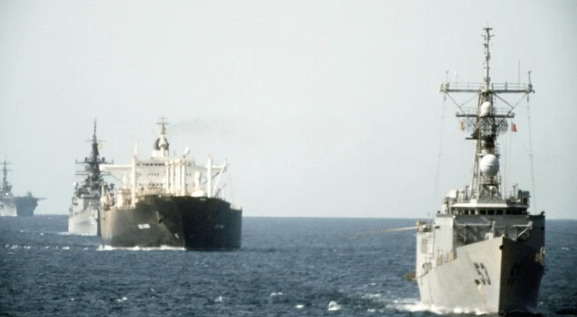
The White House expects to announce plans for an international coalition to operate a naval escort corridor through the Strait of Hormuz, officials told the Wall Street Journal. It is the latest gambit by the Trump administration to address the rising energy prices caused by Iran’s decision to blockade the strait.
After U.S. strikes on Tehran on February 28, which killed most of the Iranian regime’s senior leadership, surviving Iranian forces moved quickly to close the strait to merchant shipping (save for their own). More than a dozen ships have been hit by Iranian drones and missiles since the conflict began, killing multiple seafarers, and most international shipowners have put a pause on transits through the strait. Iran- linked tankers and a limited number of India-bound energy shipments continue to pass, but most GCC- and Western-linked traffic remains stalled and waiting.
The Strait of Hormuz ordinarily handles about 20 million barrels per day of crude oil, a significant share of the global total. Roughly six to eight million barrels from the UAE and Saudi Arabia have been rerouted to terminals on the Red Sea via pipeline. Iran’s exports of about 1.5 million barrels per day continue to flow. The remaining barrels – from Iraq, Kuwait, Bahrain, Saudi Arabia, Qatar and the UAE – are trapped, along with other commodities like LNG, urea, sulfur, natural gas liquids, helium and refined products. Oil prices have risen accordingly, and as of Sunday, Brent was trading above $105 per barrel.
The escort coalition could help to resolve this issue, depending upon details. According to the WSJ, it is not yet settled whether the escorts would begin while U.S.-Iranian hostilities were still active, or whether it would have to wait until after a ceasefire. At present, there is no firm timeline for the end of the conflict, nor a set of known U.S. objectives that (if satisfied) would trigger ceasefire talks or a unilateral declaration of the end of the war. The White House’s definition of success has varied: at the low end, U.S. leadership has claimed that victory has already been achieved with current successes, and the U.S. has “already won;” at the high end, the White House says that the fighting must continue until Iran’s “unconditional surrender.”
If combat conditions prevail while the escort mission begins, allied warships will be subject to Iranian attacks, including the same drone boat and missile threats previously directed at merchant shipping. U.S. warships have been tested under these circumstances before, during the Red Sea crisis, and have found the exercise to be demanding for crews and weapons systems. The most recent interaction occurred last week, when a U.S. surface combatant attempted to engage a nearby Iranian vessel with a five-inch cannon and failed repeatedly to hit it, necessitating a follow-up missile strike by a helicopter aircrew to eliminate the threat.
Even in calm waters, escorted convoys would be a slow alternative to free-flowing mechant traffic, according to experts consulted by Lloyd’s List. Convoys of 10 vessels at a time could be expected to slow Hormuz traffic to a small fraction of normal peacetime levels.
Oil markets appear to be pricing this reality in, and the forward curve is rising to match expectations of “higher for longer” oil. On Sunday, Energy Secretary Chris Wright said that there were no guarantees for the timing of a return to cheaper oil, and that “Americans will feel it for a few more weeks.”
“But at the end we will have removed the greatest risk to global energy supplies,” Wright said.
Related Posts