Maritime Executive: Thailand Reports Progress in Managing Oil and Containers from Sunken Ship
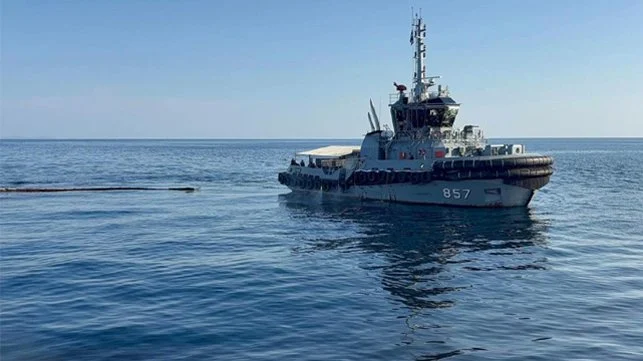
Thailand has organized an Incident Command Center and reports it is making progress in the efforts to assess and manage the situation after the cargo ship Sealloyd Arc sank on Saturday night, February 7, near a popular tourist destination. While the ship is leaking oil, so far it has not approached shore, and they report success in rounding up the containers that were floating after the ship went down.
The Sealloyd Arc is now reported to have had a total of 297 containers aboard, but 218 were loaded in the hull, with only 79 deck loaded. Initial reports said about 14 of the containers were declared on the manifest to have hazardous materials. The command has also determined that the vessel was carrying approximately 98 tonnes of heavy fuel and 32 tonnes of marine diesel oil.
One of the first efforts was to locate the wreck and determine its position. There had been concerns that the ship might have drifted from its original location as it was sinking. Using sonar, they were able to confirm the location of the vessel, and divers were deployed to survey the wreck and attach a warning buoy to the rear mast.
The ship is resting nearly upright, slightly tilted about three nautical miles south of Laem Phromthep. It was found at a depth of 61 meters (200 feet). The top of the stern mast is 14 meters (46 feet) below the surface.
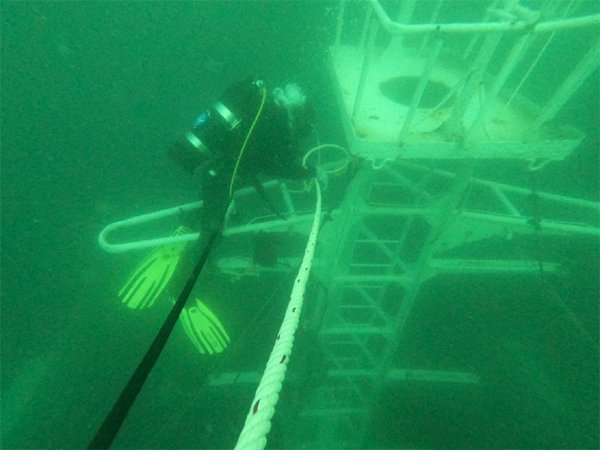
Divers reached the vessel and attached a buoy to the aft mast and surveyed the wreck site (Thai Maritime Enforcement Command Center)
The survey determined that approximately 10 containers were on the seabed around the wreck. Teams formed two groupings on the surface, one with 13 containers and the other with 6 containers. They were towing the containers and arranging for a barge equipped with a crane to begin the retrieval.
Teams are searching for additional containers, with a vessel patrolling to the north of the wreck site and drones circling the area. Another vessel was called away to handle a separate maritime emergency with a yacht. They had also planned to use an aircraft, but the position places them in the flightpath for commercial aircraft entering and exiting Phuket Airport. So far, no additional containers have been located.
Teams are also responding to the ongoing oil leak from the ship. They have deployed booms and are spraying dispersant. They believe the ship’s diesel fuel is leaking, which they point out is easier to handle with dispersant and dissolves faster than if the heavy fuel leaks. They called the efforts satisfactory while noting the wind and currents had been driving the oil southwest toward open waters.
An aerial survey shows the slick is extending for approximately 4.5 to 5 miles. So far, it has not moved toward shore, and based on oil spill modeling, they believe it is unlikely to threaten the shoreline, although it could damage sensitive marine areas.
Divers have not been able to locate the source of the leak. The first goal is to seal the leak, and drivers were planning further efforts on February 10.
The efforts are ongoing, with the information being sent to the Command Center to determine operational plans. They reported that discussions are underway regarding the possibility of salvaging the ship, although they believe the strong sea currents remain a challenge. India, after the MSC Elsa 3 went down last year off its coast at a depth of approximately 50 meters (165 feet), determined that the best actions were to seal the leaks and then pump the fuel from the tanks.
The Incident Command reported that they were meeting to review the operations, assess problems and obstacles, and determine the next steps for the operation plan.
Related Posts