Seatrade Maritime: Gemini shines as container line punctuality plummets in 2026
Just as this year’s Pacific contract season is set to begin in earnest, shippers who have historically accused container lines of over promising, over charging and under delivering, have acquired better tools to measure carrier performance.
Hapag-Lloyd and Maersk created the Gemini Cooperation in February last year with the aim of changing that view by raising on-time deliveries substantially, which they have achieved, but Gemini has largely failed to manage the 90% on-time deliveries it promised last year.
Improving on their competitors’ performances has not been a major challenge. Xeneta’s latest data reveals that global carrier punctuality has declined markedly to 30% in January, down from 36% in Q2 and 37% in Q3 of last year.
Destine Ozuygur, senior market analyst at Xeneta, gave some perspective: “Gemini at their ‘worst’ in Q1 [2026] is still 39 points above the next best alliance group in terms of on time performance; non-alliance services are coming in at 27% on time. At no point in the past 12 months has this gap been narrower than 36 percentage points at a minimum.”
Unlike other reliability providers, Xeneta calculates an on-time arrival as within 24 hours of the fixed proforma scheduled arrival, not rolling carrier ETA’s
While Gemini’s punctuality has vastly improved, the industry as a whole remains poor in terms scheduling, and Gemini, according to Xeneta data, has not achieved its stated goal of more than 90% on-time port-to-port deliveries, more than a handful of times.
June through to September saw Gemini maintain on-time arrivals above 90% for four consecutive months on the Europe to USEC services.
No period has attained the levels seen since the alliance’s first days in February 2025, with the Atlantic, Far East to North America, Europe to Middle East all recording 90% plus scheduling while the Far East to Middle East services achieved a 100% on-time arrival rate.
To achieve the substantial improvements in performance Ozuygur argues that “Gemini is prioritizing performance delivered over performance promised. Some may argue they are effectively under promising and overdelivering, but that’s why we look at actual schedules and delays.”
Gemini is leaving room for flexibility without adding excessive time to the schedules, and their transit times are still competitive with other alliances.
“They are operating with a very fine understanding of regional nuances and realistic scenarios and fine-tuning their operations accordingly. They are being realistic and flexible,” said Ozuygur.
Other shipping lines prioritise the minimum possible transit times in order to gain a competitive advantage. In doing that, however, they are overpromising and underdelivering. “They go off what is technically feasible from a physical perspective given the vessels capabilities, as opposed to what is realistic given their operational limitations and rotational structure,” explained Ozuygur.
As a result, alliance delays in January have barely increased to an average of 0.9 days for Gemini, while the next best non-alliance services average 4.3 days delayed. Ocean Alliance slipped to 4.1 days late and the Premier Alliance performed the worst with an average arrival of 5.9 days after the scheduled arrival time.
According to Ozuygur these delays have changed little since the outset of a new network structure. And that matters because it is a sign of resilience for Gemini: “While the total number of late vessels may have increased, the delays have not increased in severity. That signals control and resilience.”
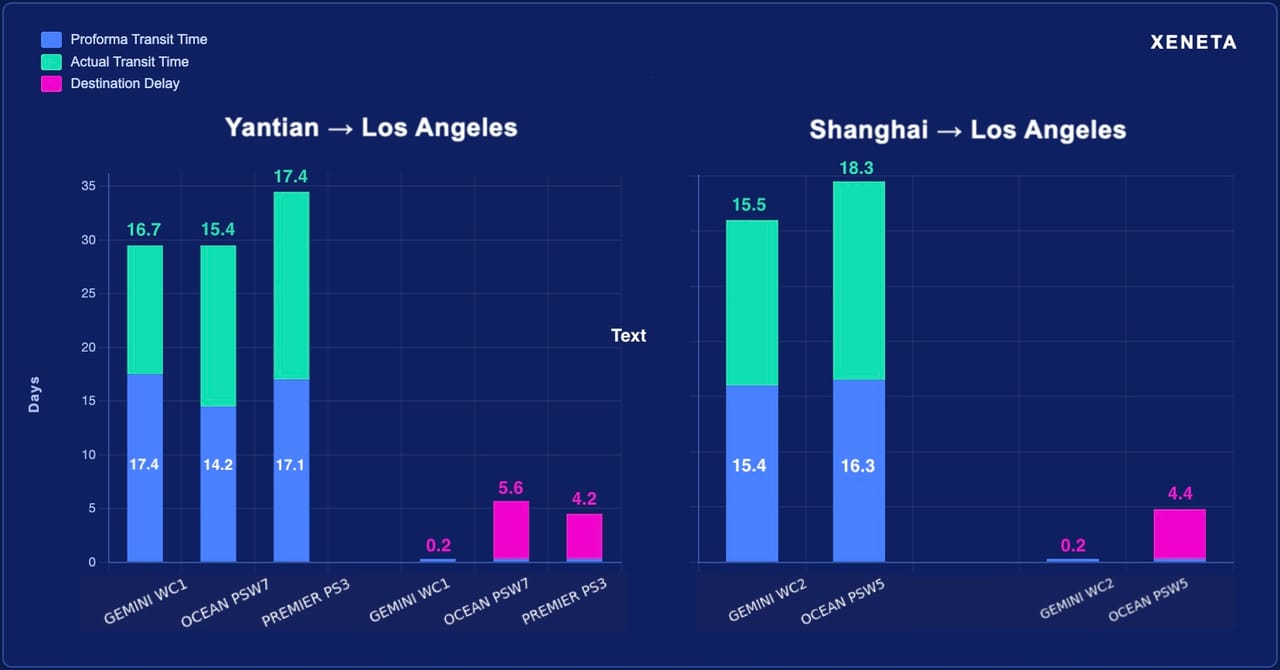
Transit Time Padding: Port Pair Comparisons on Transpacific (3-month averages):
Yantian -> Los Angeles
GEM – WC1: 17.4 days proforma Transit Time, 16.7 actual TT, 0.2 days destination delay
OCEAN PSW7 14.2 days proforma TT, 15.4 actual TT 5.6 destination delay
PMR – PS3 17.1 days proforma TT, 17.4 days actual TT 4.2 days destination delay
Shanghai -> Los Angeles
GEM – WC2 15.4 days proforma TT, 15.5 actual TT 0.2 days destination delay
OCEAN – PSW5 16.3 days proforma TT, 18.3 actual TT 4.4 destination delay
In the past six months there have been seven Gemini vessels, out of 23 in total on the WC2 that departed Shanghai over 24 hours delayed. Only three of those arrived at Los Angeles late, of the ships that did arrive on time none were more than five hours delayed.
By comparison in this period the Ocean Alliance’s PSW5, saw 16 vessels out of 23 depart from 24 hours to seven days late. Some 21 of these vessels arrived late, with the next five in the lineup expected to arrive late too. Out of that total 14 ships were from three to seven days late.
Ozuygur commented: “This means that not only is the transit time padding for the PSW5 insufficient to ‘gain back’ any of that delay in a meaningful way, but vessels that were still within the 24 hour window grace period take on even more delay as they cross the Pacific because they’re already maxed out in terms of schedule flexibility.”
Related Posts