Seatrade-Maritime: LR and Maersk assess Rotterdam nuclear ship call feasibility
Published by Seatrade-Maritime
The main barriers to the adoption of nuclear-powered ship port calls are regulatory alignment, governance, risk management integration and public acceptance, according to a new joint study from Lloyd’s Register, Core Power, Maersk, and the Port of Rotterdam.
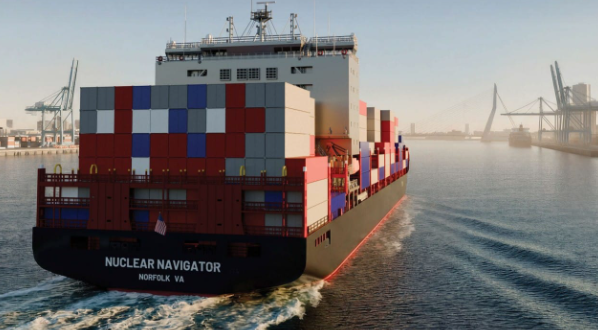
The study looked at a scenario where a high-level nuclear ship design carried out a port stay at an EU port, and its findings are aimed at informing decision making by EU ports and authorities.
The partners’ desktop study found categories of barriers that apply to ports across the EU, including a lack of specific provision for nuclear ships in existing regulations, limited integration between maritime and nuclear safety regimes, and a lack of guidance for ports on how to interpret nuclear licensing, insurance and liability for visiting nuclear ships.
The main output of the study is a roadmap of activities to overcome barriers to nuclear ship adoption, aimed at EU ports and authorities. “The assessment demonstrates that nuclear ships can be evaluated using the same safety themes and processes already applied to other high-risk maritime activities. Where gaps exist, they are typically due to a lack of guidance rather than technical incompatibilities,” said the report.
Near-term activities on the roadmap — those that should begin within the next five years if they haven’t already — are loosely grouped as development of nuclear ship designs and conducting risk assessments, publishing and communication of risk management activities, development of guidance for nautical safety and port security, and collaborative updates to international codes at IMO and IAEA, or development of new international codes.
Addressing public perceptions of nuclear power are a priority, as early communication would make it easier to address regulatory, liability, and legal gaps.
Port specific standards may need reviewing, the report said, such as Rotterdam’s temperature restriction for discharged cooling water.
The medium-term activities are those that follow on from near-term activities and need to be in place before commissioning of the first nuclear-powered ship. They are development of public engagement strategies; producing recommendations for liability, training, and security in port; establishing measures for safety and security in ports; and national implementation standards.
International and national guidance will be required for a wide range of activities, including emergency response, berthing, port-related safety aspects, operational procedures in port, and training of ship and port personnel to handle normal and emergency operations, said the report. Development of such guidance will require the inputs from the near-term activities on nuclear ship design and operation.
Liability and insurance frameworks for nuclear shipping will also require a certain level of understanding of technical and operational risks, and will therefore be a medium-term issue.
Operation of the first nuclear-powered ships will require multilateral agreement between nations to accept nuclear operating licenses; valid insurance for ship and ports; marine regulatory approvals from class, flag and coastal states; certified and trained ship and port operators; and permits to enter ports with required preparations are in place.
In the long-term, required activities will be the refining of regulations and policies in-line with technology development, and the establishment of mutual recognition of nuclear ship licenses at the national level.
Ole Graa Jakobsen, head of fleet technology, A.P. Moller-Maersk said: “Civil commercial nuclear propulsion presents a number of significant challenges, including safety, waste management, regulatory alignment and public acceptance across regions. This study does not represent a decision to pursue nuclear propulsion, but contributes to further understanding of what would be required for ports and authorities to assess such vessels in a structured and responsible way. We continue to monitor and assess this technology alongside other low-emission solutions.”
Mikal Bøe, CEO of Core Power, said: “An obvious key to the success of civil maritime nuclear propulsion is the trusted confidence of port cities and their populations in ship calls by nuclear powered merchant ships.
“Together with Rotterdam, LR and Maersk we’ve identified a port safety framework and created a credible starting point for assessments by the IMO as it revises the Safety Code for Nuclear Ships and for the IAEA as it launches its flagship ATLAS program this summer. We’ve highlighted where further work is needed, including modernised port guidance, inter-agency regulatory alignment, nuclear-specific safety, and security requirements and best in class emergency preparedness to build public trust.”
Harbour master of the Port of Rotterdam, René de Vries said: “Ports need to understand how emerging energy and shipping technologies may interact with future port operations and industrial systems. This study represents an initial case-study assessment intended to better understand the regulatory, operational and safety considerations associated with nuclear-powered commercial shipping within a European port context.”
Meg Albrecht, senior engineer – nuclear technology and alternative fuels, Lloyd’s Register, said: “The maritime energy transition will require the industry to examine a range of future fuel and propulsion pathways. This work contributes to a broader understanding of the regulatory and operational considerations associated with nuclear-powered vessels and helps establish a structured basis for further discussion and analysis.”The full report Enabling Nuclear-Powered Feeder Ships: A Joint Development Project on Port Call Feasibility and Regulatory Pathways is available to download from the Core Power website.
Related Posts