
Seatrade Maritime: Overcapacity paradox leading to two tier container market
Global trade has expanded faster than was anticipated two years ago according to some observers leading to an easing of the imbalance between supply and demand in the container industry.
That view is, however, tested by a more detailed look at the capacity statistics, which show a much more nuanced situation that could lead to a two-tier container shipping market as manufacturing companies diversify their production sites and the east-west trades become less important in the future.
In addition, Antonella Teodoro, an analyst at MDS Transmodal has identified a Red Sea fleet paradox that is developing with an overcapacity in the larger vessels and shortages in the smaller sizes.
“The reopening of the Red Sea will not simply restore pre-crisis shipping conditions. It reveals a deeper, structural imbalance in the global fleet: chronic oversupply of megaships on the main East–West routes, and a rapid decline of the small and mid-size vessels that regional and secondary corridors increasingly depend on,” explained Teodoro.
Should transits of the Suez Canal return some 6–8% of global container capacity, around 2 million teu, that is tied up in extended voyages around Africa will be added to the total, with another 9.5 million teu on order up to 2030.
“While some congestion in Europe may temporarily absorb excess tonnage, the underlying imbalance will remain,” said Teodoro.
Nevertheless, Hapag-Lloyd CEO Rolf Habben Jansen believes that a compound growth rate of 12%, 6.5% growth in 2024 and 4.7% in the first nine months of this year, means that global trade is increasing faster than expected.
“I think we have been debating for about a year and a half now about whether inventories are very high and whether there’s a lot of front loading here and there, but the development of global trade, I think, has been much better than many people feared,” declared Habben Jansen, in a webinar discussion with Vespucci consultant Lars Jensen and Michael Aldwell, the EVP for sea logistics at Kühne+Nagel.
While the US trades have been under pressure all the other trades have experienced growth said Habben Jansen including Europe, Asia, Latin America and Africa, “I think that is why we’ve seen substantially more demand growth than everybody anticipated,” he added.
According to the Hapag-Lloyd executive growth in these other regions has seen the optimism in the container shipping industry increase as a result.
For Jensen regional growth is a symptom of trade diversification, and that shift began before the liberation day tariff destabilisation.
Moreover, Hapag-Lloyd argues that as shifts in trade become more common the industry has improved its reaction times to fluctuations in the market, shifting capacity to regions where it’s needed.
“If you look at the last number of years, then you will see that the industry has become a lot better at adjusting quickly, because usually in the past we could take months to do that, now I think you typically see that happening within weeks,” said Habben Jansen.
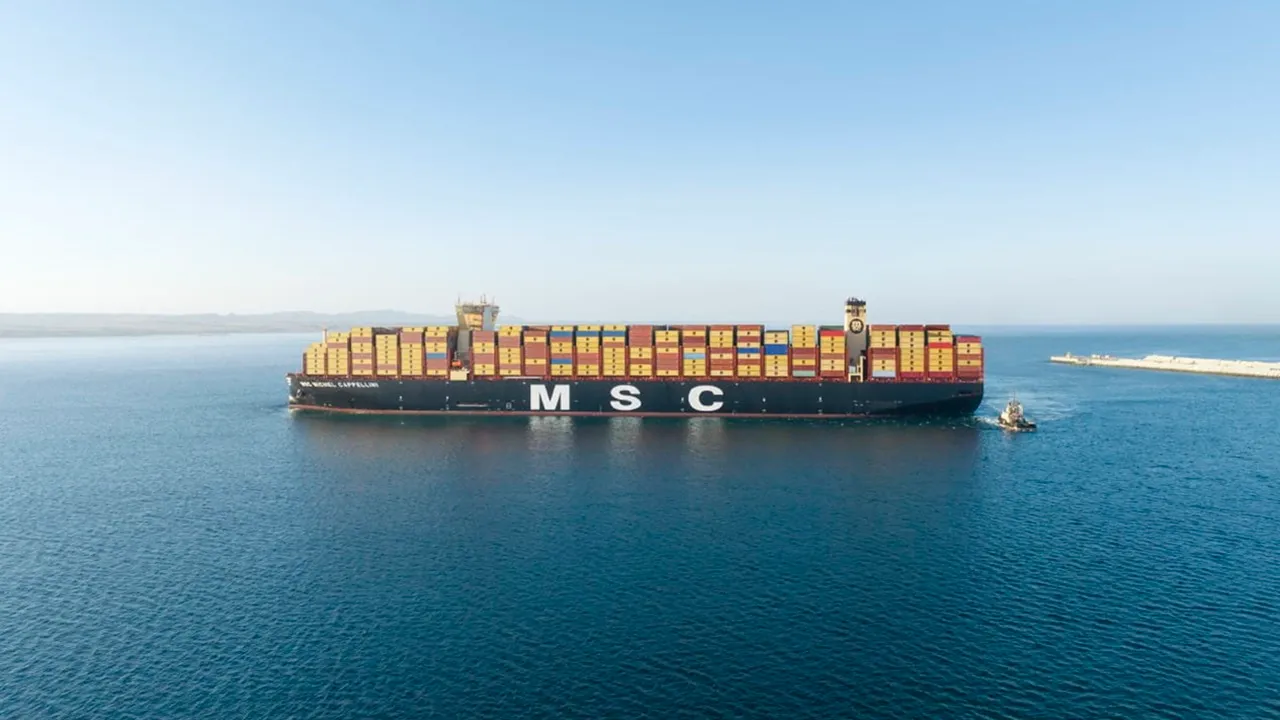
Megaships are, however, causing a structural oversupply of capacity, said Teodoro, with the increase in the fleet of vessels over 10,000 teu expanding by 50-100% with little scrapping in this division of the global fleet.
“Many ports cannot accommodate these ships, and their scale makes them unsuitable for the multi-port rotations that define regional and secondary trades. Cascading options are therefore limited, locking the industry into a phase of oversupply on the main East–West corridors,” said Teodoro.
Jensen agrees that the orderbook remains too large and we will have to see some scrapping to “mitigate” the effects of capacity becoming operational, however, he adds that it is unlikely that there will be a crash.
“What I see structurally is what I would call a fairly normal cyclical downturn in the industry,” said Lars Jensen, “To me, a crash is what we saw during the financial crisis, 2008-09, for example. That is not what we’re heading into, we are heading into overcapacity like we did in 2015-16.”
Habben Jansen largely agreed with Jensen’s analysis, saying that scrapping will increase in the second half of this decade, but with demand stronger than previously thought, “And when you look at deliveries in 2026 they are actually not very high,” he said.
Moreover, both Habben Jansen and Jensen agree that if there was a phased return to the Suez Canal there would be congestion in Europe as vessels from the Cape route arrived at the same time as the faster ships operating via the Red Sea and Suez.
Shippers would see freight arriving in bunches and there would need to be a plan to shift freight from port storage rapidly to avoid exacerbating the congestion.
Jensen believes that the transition to Suez could start in the lull after Chinese New Year, which in 2026 will end in early March, and that could cause “massive disruptions”.
Kühne+Nagel’s Aldwell added that a major US restocking could also see demand rise substantially particularly if the Supreme Court rules that the Trump administration’s tariffs are unlawful.
A similar restocking in 2001 saw a 20% spike in demand, said Jensen, and that will increase pressure on rates and increase volatility, added Aldwell. A point that Jensen also emphasised.
With the level of megaship newbuildings due to be delivered over the coming five years, it seems unlikely that there will be a capacity squeeze on the major east-west trade lanes. The capacity crunch will be felt in secondary and north-south trades where the diversification that Habben Jansen, Jensen and Aldwell identified is taking place.
As Teodoro points out: “Sub-5,000 teu vessels are ageing rapidly — more than 60% are over 25 years old — and few replacements are on order. By 2030, the global fleet below 2,500 teu could contract by 40–80%. This matters not only for island and shallow-draft ports but also for key trade corridors.”
Routes such as North America–Europe, North Europe–Sub Saharan Africa, North America–Latin America depend heavily on mid-sized vessels.
“As this segment shrinks, these trades could face reduced service options, higher freight rates, and weaker connectivity,” claimed Teodoro.
.jpg?width=1280&auto=webp&quality=80&disable=upscale "Connectivity_Hi_Res_(png).jpg")
According to MDS Transmodal data, orders for vessels below 10,000 teu number 426 ships; conversely the number of vessels in that category that will be over 25 years-old are 1,932.
Container shipping is navigating a route to a bifurcated market for the rest of the decade, according to MDS Transmodal.
“The unwinding of the Red Sea crisis will expose a fleet moving in two different directions, mainline routes will be structurally oversupplied and dominated by megaships that cannot be cascaded. And regional, feeder, and mid-range trades will see a tightening as small and mid-size vessels disappear faster than they are replaced,” explained Teodoro.
She concluded that: “This divergence will shape port development, shipping strategy, and global trade patterns for the rest of the 2020s. The Red Sea crisis may soon end, but its unwinding will reveal a fleet whose greatest challenges are only just beginning.”
Related Posts


