Shippingtelegraph: Maersk has 10 container ships trapped in Upper Gulf, chief Clerc says
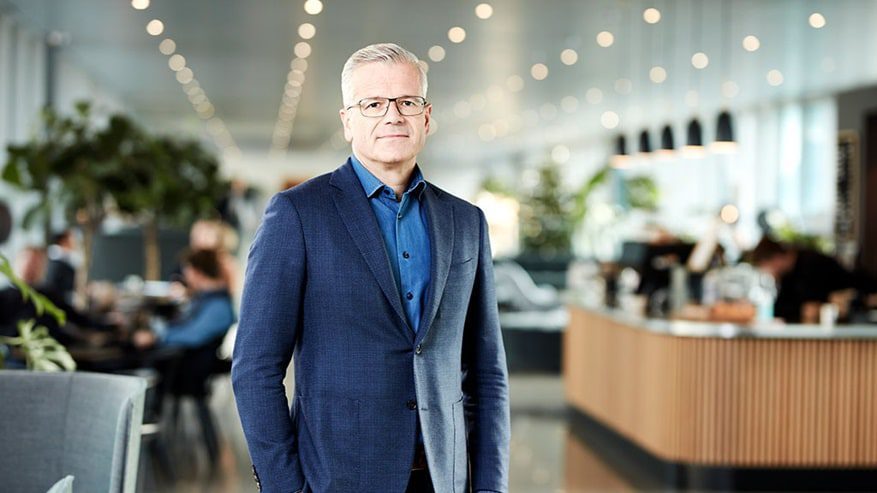
Danish shipping giant Maersk has reported that ten container ships are trapped in the Upper Gulf, while there are numerous other ships that are on their way to the region.
“The ships cannot get out,” the company’s chief executive Vincent Clerc said in an interview to CNN’s Quest Means Business hosted by Richard Quest.
Vincent Clerc joined CNN’s Quest Means Business to discuss the current disruptions affecting global shipping and supply chains.
He highlighted the challenges posed by the closure of the Strait of Hormuz and the impact on the shipping industry. Clerc emphasized the importance of agility in Maersk’s network to respond quickly to various disruptions, including tariffs and geopolitical shifts. He also discussed Maersk’s approach to the situation in the Red Sea, advocating for a safe passage for vessels.
“So, we have 10 ships right now that are stuck in the Upper Gulf and can’t get out, and we have numerous ships, in the tens of ships that are on their way to the region and for which we have had to have contingencies about where they’re going to drop the cargo. They are not going to wait for the Strait to reopen. We will stage the cargo either in Oman or in Jeddah or in other places, in ports where we have access, and then the ship will go on their way to their next assignment from there,” the chief executive stated.
With the current security environment surrounding the Strait of Hormuz, and with transits through the Bab el‑Mandeb Strait being suspended as a precaution, vessels are being rerouted and cargo is being staged through alternative hubs, Vincent Clerc shared.
“We are clearly in uncharted territory,” the chief executive warned, adding that Maersk is in constant dialogue with the Chinese government on multiple issues, including the energy crisis. “It is only natural for the Chinese government to be concerned about how this is shaping and to have dialogue with some of the strategic partners that serve China on other segments,” he emphasized.
Vincent’s perspective on how the industry and the company is navigating these challenges can be found in the following interview to CNN.
Quest: It is the Strait of Hormuz. So you’re not going into that waterway. Are there any other areas that you’re avoiding at the moment?
Clerc: So for us, the Bab el-Mandeb Strait between the Arabian Sea and the Red Sea is also closed as a precaution, because you will remember that for the last two years, we have been subject to attack by Houthi militias in Yemen, which are a proxy of Iran and we feel that as much as the war so far has been focused on the Upper Gulf, there is a risk that militia – that the proxies are being mobilized and start to take international shipping again as a target.
And therefore, we have decided to reverse the reopening of the Red Sea and continue to sail the long way around Africa.
Quest: The idea of either the U.S. government or any government providing war insurance or some form of insurance and guarantees or indeed escorting your vessels through the Strait. I’ve heard that that’s a bit of a nonstarter. What do you say?
Clerc: Yes, I think that – I think the most important thing to start with is to say that we have colleagues on board those ships, and we will never take a solution where it is just because we have insurance, but we put them in harm’s way, we are going to find that the solution is okay.
We are only going to act if we feel that the safety of our crew, the safety of our assets, the safety of our customers’ cargo can be guaranteed by the solution that has been put in place.
Whether it is a negotiated solution or whether it is a military solution, there are political authorities that need to decide what is the quickest and best way to reopen the Strait, but for us, safety remains our primary concern and ensuring the safety of our operation, that is not something that we are going to trade on.
Quest: What do you make of the Chinese calling you and MSC in to basically complain about higher surcharges or premia because of extra costs? Freight charges are going up and now the Chinese are piling on with their complaints to you. What have you told them?
Clerc: I think it is important to understand that a lot of the flow of oil that comes out of the Gulf actually is serving the needs of the Arabian Peninsula, but also of Asia, and therefore, this energy crisis could have significant consequences on Asian economies, and it is only natural for the Chinese government to be concerned about how this is shaping and to have dialogue with some of the strategic partners that serve China on other segments.
We don’t do tankers, but on other segments and want to engage on how is the picture evolving, how are we going to deal with some of that?
They do understand that the significant cost increases we are faced with right now, as a result of this situation, we cannot shoulder by ourselves, but they also want to make sure that there is fairness in the way that we deal with them, which I think is a fair concern and were in constant dialogue with the Chinese government on multiple issues and this is just one that is quite high on the agenda right now.
Quest: I mean, Maersk, a giant, you’re well used to crises. This is – you’ve faced everything at some point as a shipping company but this is on a scale that is almost impossible to manage. So, what do you make of it?
Clerc: I mean, we are clearly in uncharted territory. I think the main concern we have more or less resolved today the safety of our crews for the time being, to the best of our ability, we have solved for the cargo flows to the best of our ability. I think the big problem that we have to solve now is with the Strait being closed, there is enough oil in the world, but there is not enough oil everywhere in the world.
There is dislocations in the market where some areas have plenty of fuel and other areas could face shortages. And we need to be proactive in moving fuel around so that when we come to ports, we actually have the fuel that we need to keep on powering our network on and that is something that is completely new.
So I think for me, the only parallel that there is COVID, where something we hadn’t tried before either, where we need to really familiarize ourselves with completely new areas, such in this case, moving fuel around the globe so that we have the right amount in the right time at the right price.
Related Posts