Splash247: Chaos and conjecture as Ukraine widens drone war
A fresh wave of Ukrainian attacks and unexplained incidents has deepened uncertainty for vessels trading Russian cargoes — sanctioned or otherwise.
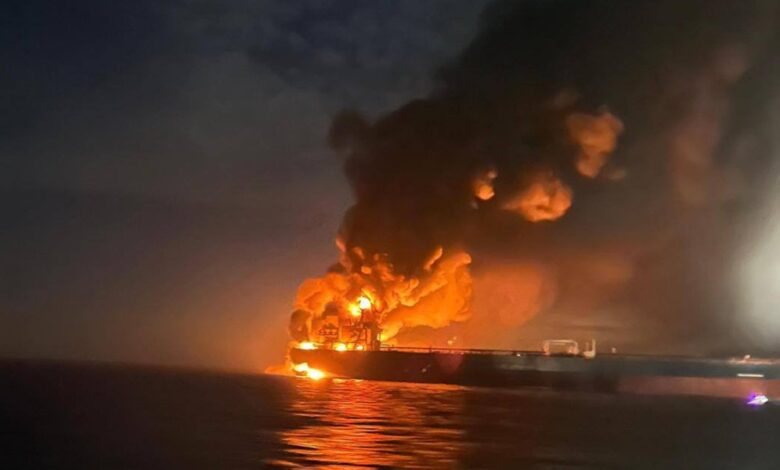
Coming just days after Kyiv claimed the use of Sea Baby naval drones to strike two Russia-linked shadow fleet tankers – the Kairos suezmax (pictured) and the Virat aframax – in the Black Sea, a third casualty has now emerged thousands of miles away.
The 50,100 dwt, Panama-flagged product tanker Mersin, owned by Turkey’s Mersin Shipping and managed by Besiktas Shipping, is listing off the coast of Dakar after water entered its engine room. Senegalese authorities are racing to stabilise the vessel and prevent a spill, deploying tugboats, navy personnel and anti-pollution barriers around the stricken ship.
All crew were rescued without injury. No cause has yet been confirmed. But speculation has been unavoidable.
Mersin has long been engaged in transporting refined products from Russia to Africa and South America and has been anchored off Dakar since late September. Its last AIS signal was recorded on November 23. Images shared online show the stern perilously close to the waterline.
The timing of the incident, so soon after high-profile strikes on Russian-linked tonnage, has fuelled conjecture in the market — even though Mersin is not sanctioned, is G7 price-cap compliant, and has a known beneficial owner.
Ukraine’s stated focus remains on vessels that are falsely flagged or linked to the shadow fleet, which reduces diplomatic fallout from attacking merchant ships. Yet the line between sanctioned targets and legitimate commercial trade appears to be blurring.
Five vessels this year — Vilamoura, Grace Ferrum, SeaJewel, Seacharm and Koala — have already been damaged in mysterious blasts, with one common thread: all had previously called at Russian ports.
Analysis by maritime analytics firm Windward strongly suggests that the Mersin was targeted by Ukrainian special forces.
“The Mersin is more than a sinking ship. It’s a warning that opaque Russian oil flows are not ‘cost‑free’ for the world. If this can happen off Senegal, systemic risk is already sitting off coasts everywhere,” commented Ami Daniel, Windward’s CEO, in a post on LinkedIn.
At the same time, the Caspian Pipeline Consortium (CPC) has halted loadings at its offshore terminal near Novorossiysk following what it describes as a “targeted attack” on one of its single-point moorings. The CPC normally handles more than 1% of the world’s oil supply and is co-owned by Chevron and Exxon, despite its oil flowing through Russian territory.
Exports from the terminal have already dropped sharply in recent months. Any prolonged disruption could hit suezmax and aframax demand.
Ukraine has not claimed responsibility for the CPC strike, but Kazakhstan has condemned any action against what it calls “civilian international energy infrastructure,” warning of wider consequences for global energy security.
Related Posts