Splash247: Containers seen flying across Lake Geneva
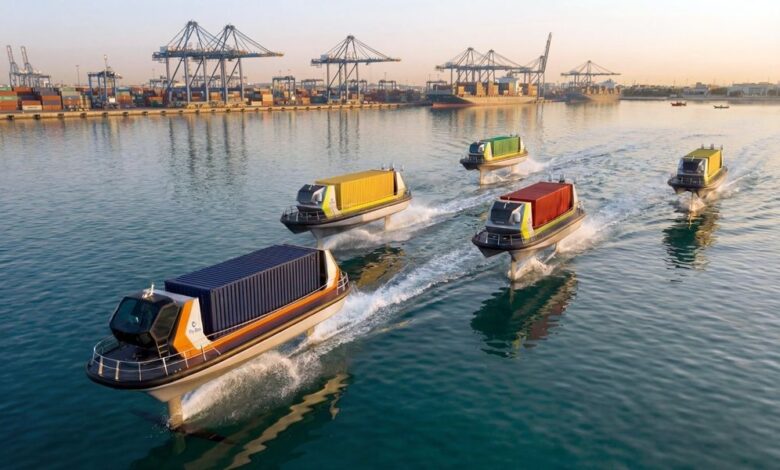
Franco-Swiss maritime startup Fly-Box is moving its foil-borne container concept into the next phase, launching a detailed techno-economic assessment with a global player active in both shipping and terminal operations.
The move follows a busy year for the deeptech firm, which has been lining up pilot routes in the Gulf and successfully flying a scaled prototype over the summer. The new assessment will benchmark Fly-Box’s platforms against trucks and conventional feeder vessels using real-world operating scenarios.
Fly-Box is targeting a long-standing pinch point in container logistics: the move between main hubs and secondary ports. Today, those flows are split between feeder ships designed for volume rather than speed, and long-haul trucking that adds congestion, emissions and cost, particularly around major ports.
The company’s answer is a 20-m, foil-borne platform capable of carrying a single 40ft container at around 25 knots. Operating from shallow-draft berths and using standard port equipment, Fly-Box said its platforms could offer an “express” coastal shipping option, moving boxes quickly out of busy terminals and closer to end customers by sea.
“With Fly-Box, the sea regains its role in port-to-port transport,” said chief operating officer Antoine de Roquefeuil. “On many routes, our next-generation coastal shipping pushes trucking back to where it adds the most value — the last miles.”
The ongoing study with the unnamed industry partner will dig into capital and operating costs, emissions performance and system integration. This includes how the platforms would plug into terminal operating systems, port community systems and vessel-tracking tools, as well as practical issues such as navigation, energy supply, safety and maintenance.
Fly-Box positions its platforms as a standard, add-on element within existing multimodal chains rather than a disruptive overhaul. By multiplying short-sea connections, the company argued the concept could also bring container traffic back to smaller ports that have been sidelined by the concentration of flows into a handful of mega-hubs.
Looking further ahead, Fly-Box is betting on software and automation as key differentiators. The long-term goal is to operate fleets of platforms as autonomous or remotely operated “swarms”, something the company believes is more achievable at sea than on crowded roads. Foils play a central role, lifting the hull clear of the water to cut drag and reduce energy use by up to 30–40%, while improving speed and schedule reliability in choppy conditions.
The startup has drawn expertise from America’s Cup and hydrofoil projects, as well as energy and systems specialists from the automotive and academic worlds. Its 8-m demonstrator flew this summer on Lake Geneva, validating core design choices, with a further test programme planned next spring.
Backed so far by three family offices from France, Belgium and the UAE, Fly-Box is now seeking a fourth investor to close its pre-seed round. That funding would support the design and construction of its first two full-scale pre-series units.
“Two years after the initial idea, the prototype is flying and discussions with industry players are accelerating,” said founder Alain Thébault. “A new, automated building block on the water is starting to take shape.”
This is not the first time Splash has reported on containers going aerial. Back in 2021, Qingdao port in northeast China unveiled its skyrail method to shift boxes.
Related Posts