Splash247: Shanghai’s box boom exposes a resilience blind spot
In container shipping, the leverage – and the real fragility – now lives where the cranes greet the sea, writes Wolfgang Lehmacher.
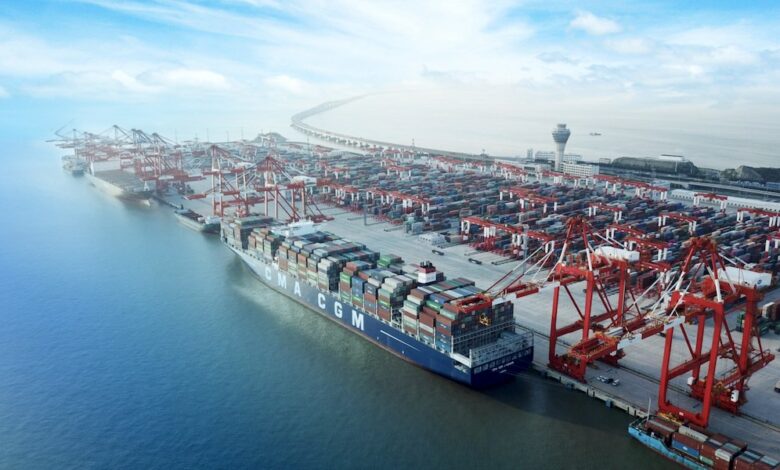
Shanghai has just pulled off something remarkable, even by its own lofty standards. The world’s largest container port handled more than 46m teu in the first 10 months of 2025, up 6.5% year-on-year, at a time when China’s overall goods trade by value expanded just 3.6% over the same period. That gap sums up a new reality for shipping: ports and networks can power ahead even as macro growth flattens.
Last year, Shanghai became the first port in history to cross the 50m teu mark, cementing its run at the top of the global rankings. Official statements from Shanghai International Port Group and Chinese authorities underline what the numbers already say: this is not a short term spike, but the confirmation of a structural role as a global exchange hub, with rising volumes of transhipment and ship-to-ship moves on top of import and export flows.
The backdrop is a Chinese economy that is no longer racing ahead. State statistics put total imports and exports at around RMB37.3trn in the first 10 months of this year, with growth slowing modestly as domestic demand remains under pressure and policymakers talk of “high quality development” rather than raw speed. At the same time, trade with Belt and Road partners and the ASEAN region is growing faster than the average, and private manufacturers are taking a bigger share of the export pie, particularly in electric vehicles, batteries and solar kit.
Put those threads together and a different picture emerges. China’s ports are handling boxes faster than its economy is growing. UNCTAD’s liner shipping connectivity index has long ranked China at or near the top globally, and Shanghai sits at the sharp end of that network. The Yangshan deepwater complex links into some 350 international services and more than 700 ports worldwide. The flows are starting to tell a different story from the GDP tables.
There is also a tariff angle. This has been a year of frontloading and preordering as shippers try to stay ahead of new US and other trade measures. Analysts tracking container flows and freight rates point to strong spring volumes out of China and Asia as importers pulled forward orders. But frontloading is a temporary trick. It creates bulges around deadlines, not the sort of sustained 6.5% growth Shanghai is reporting across most of the year.
What matters for BCOs is where risk is building up. A European tier one automotive supplier recently ran a resilience review after moving some assembly to Southeast Asia under the a China plus one plan. On paper, only about 40% of its production was still in mainland China. On the water, more than 70% of its deepsea containers were still flowing through Shanghai and other Chinese hubs as origin, consolidation or transhipment stops. The footprint on land looked diversified; at sea it did not.
What is good business for ports and lines, is a growing exposure for cargo owners and forwarders. Chinese operators and investors now have stakes in terminals across the global south, while China’s own coastal gateways are shifting more cargo into containers and hub and spoke networks. The net effect is a system where a handful of mega hubs, with Shanghai at the front, carry an outsized share of the world’s loaded boxes.
What should shippers and BCOs do with that insight?
One answer is to start measuring port dependence with the same seriousness they apply to supplier concentration. That means looking across the network and asking: what share of my teu and cargo value touches a small group of nodes, including transhipment moves? Which SKUs truly depend on those hubs? Who owns and operates the terminals involved? That is the sort of lens UNCTAD applies at country level with its connectivity scores. It might be overdue in boardrooms.
The second step is to treat routing like a portfolio, not just an operational choice. On every major lane, shippers can design at least two viable patterns: one via a Chinese hub, one via a non-Chinese hub. Then they should model cost, time, emissions and regulatory risk for each. Scenario work and simulations can show how quickly volumes could be rebalanced if a port, country or alliance hit trouble. That turns China plus one from operational redesign into a routing strategy.
The final point is that engagement, not avoidance, will decide who comes out ahead. Shanghai is cast domestically as a window on China’s opening and as a pillar of its development model. Its record throughput confirms that it will remain central to global trade for years to come. At the same time, green corridors, digital platforms and new regulatory risks are emerging around these hubs. Cargo owners that sit outside those conversations will still bear the dependence, but without the influence.
Shanghai’s 6.5% box growth in a 3.6% trade world is not only another record for the history books. It is also a warning that resilience can no longer be judged only by where factories sit on the map. In container shipping, the leverage – and the real fragility – now lives where the cranes greet the sea.
Related Posts