Seatrade-Maritime: The rise of AIS ‘trolling’ in the Strait of Hormuz
Published by Seatrade-Maritime
The interference and spoofing of AIS navigation data has become a common problem and been particular prevalent in and around the Strait of Hormuz since the start of the war between US/Israel and Iran.
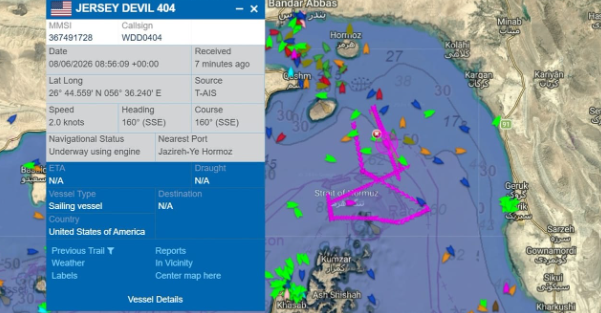
The past couple of weeks have seen the rise what is best described as AIS “trolling” with signals appearing with fictious names such as the supposedly US-flagged Jersey Devil 404, Opium Cargo, and Dead Wallet Crew. The tracks of many these vessels are erratic and clearly false.
Unlike AIS spoofing the manipulation of vessel identities does not appear to be done for practical reasons such as masking a voyage or evading sanctions, and it is unclear who is behind the manipulation or why.
Arsenio Longo, Founder of Huax maritime intelligence platform, who has been monitoring the trend, explained to Seatrade Maritime News, “Some cases seem to involve real, registry-resolvable vessel tracks where individual AIS fields, such as destination, display name or voyage information, have been polluted with provocative text. Other cases look closer to synthetic contacts, meaning targets that appear on the AIS map but do not clearly correspond to a verifiable physical vessel.”
As to who is behind the manipulation this is unclear and Longo said they have not seen any credible claims of attribution although it is being discussed in the trading and maritime security community. He describes the silence as “interesting”.
However, for Huax the issue is less who is behind the manipulation than the fact it is happening at all and at time when the area the Strait of Hormuz is being so closely monitored.
“For us, the bigger point is not attribution. The bigger point is that these messages can enter the public AIS picture at all. Whoever did it, the capability is there. The gain may not be operational concealment in the classic sense. It may simply be attention, provocation, narrative disruption, or a way to show that the maritime picture everyone is watching can itself be polluted. In a place like Hormuz, even small distortions travel far because so many actors are watching the same screen.”
In terms of the impact Longo noted that AIS was a safety built for navigational safety not for public information or messaging.
“Nobody on a bridge is going to mistake a name like Craiglist Crude for a normal tanker. But that is not really the point. Every anomaly still has to be checked, filtered and explained. That takes attention at a moment when the environment is already tense and clarity is hard to maintain,” he explained.
“In open waters this may look like noise. In the Strait of Hormuz, where commercial shipping, naval forces and intelligence services all watch overlapping versions of the same maritime picture, even noise has an operational cost.
“A single prank is manageable. What is more serious is that the AIS picture can be polluted at several levels: the vessel identity, the voyage metadata and, in some cases, the contact itself,” Longo said.
Related Posts